
Bonus Poker Deluxe: When Two Pair Is No Longer Enough — Full Paytable Breakdown and Player Mistakes
Bonus Poker Deluxe is often perceived as a simplified version of classic video poker. The interface looks familiar, the rules follow the traditional five-card draw format, and the paytable appears generous compared with many casino games. However, experienced players know that the real complexity lies in the mathematical balance of payouts and the strategic adjustments required to achieve optimal returns. In this version of video poker, the value of certain hands changes how players should approach decision-making, and one of the most common misconceptions concerns the importance of Two Pair. While this hand pays reliably, relying on it too heavily often leads to long-term losses.
Understanding the Structure of Bonus Poker Deluxe Paytables
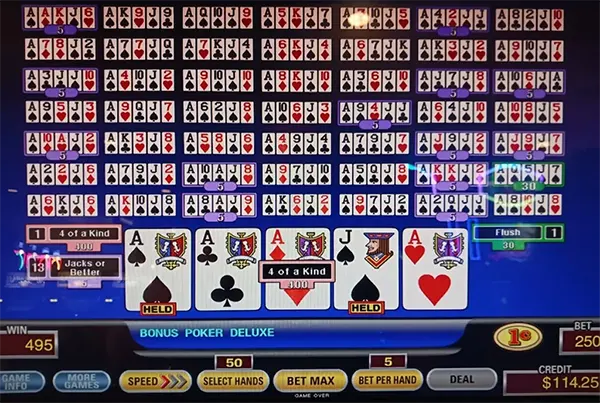
The defining feature of Bonus Poker Deluxe is its distinctive paytable. Unlike variants such as Double Bonus or Deuces Wild, this game keeps the payout for Four of a Kind consistent across all ranks. This means that four twos, four tens, or four aces typically pay the same amount. The standard full paytable version often pays 80 coins for a Four of a Kind when betting five coins, which is lower than some other video poker variants but more evenly distributed across hands.
Another important element is the payout for Two Pair. In Bonus Poker Deluxe, Two Pair usually pays 1 to 1, meaning the player simply receives the amount they wagered. This structure stabilises the game by providing frequent small wins. However, the lower reward for Four of a Kind means that overall profitability depends heavily on strategic play rather than occasional large payouts.
The return-to-player rate for the optimal paytable version typically approaches around 99.6% when perfect strategy is applied. This number assumes that players follow mathematically correct decisions on every draw. Any deviation from optimal play quickly reduces the expected return, which is why understanding the paytable is crucial.
How Payout Distribution Changes Player Decisions
In many video poker games, the most profitable approach focuses on chasing high-value hands such as Four of a Kind or Straight Flush. Bonus Poker Deluxe changes this dynamic slightly because the reward structure spreads value more evenly across several hands. As a result, consistent mid-tier wins become an important part of the bankroll cycle.
Two Pair appears frequently enough to give players the impression that it represents a strategic anchor. The psychological effect of frequent small wins can encourage players to prioritise preserving Two Pair rather than discarding cards in pursuit of stronger combinations. In practice, this approach reduces the mathematical efficiency of the strategy.
Optimal play often requires breaking seemingly safe combinations. For example, holding a high pair with a four-card flush draw may produce a better long-term expectation than keeping Two Pair. These decisions contradict instinct but are supported by probability models used in professional video poker strategy charts.
Common Strategic Mistakes in Bonus Poker Deluxe
One of the most widespread mistakes is overvaluing Two Pair. Many players treat this hand as a guaranteed stopping point because it secures a payout. While this approach protects the immediate bet, it eliminates the possibility of improving the hand to a Full House, which offers significantly higher value over time.
Another frequent error occurs when players ignore kicker strength in certain situations. For instance, holding a high pair with strong kicker cards may create opportunities to build straights or flushes. Inexperienced players often discard these possibilities simply because a small payout already exists.
A third strategic problem comes from misunderstanding draw probabilities. Video poker relies on calculated odds rather than intuition. When players break mathematically favourable draws due to short-term thinking, the house edge increases quickly.
Why “Safe Play” Often Reduces Long-Term Returns
The instinct to secure a guaranteed win is common in casino games, and Bonus Poker Deluxe encourages this behaviour through its frequent Two Pair payouts. However, safe decisions often conflict with optimal mathematical strategy.
Consider a situation where a player holds Two Pair with one card remaining to draw. The correct strategy is typically to discard one card and attempt to improve the hand to a Full House or Four of a Kind. Although the improvement does not occur frequently, the larger payout compensates for the risk over many rounds.
Players who always keep Two Pair instead of drawing for improvement reduce their theoretical return significantly. Over thousands of hands, this conservative behaviour results in measurable losses compared with players who follow the mathematically correct approach.
Practical Strategy Adjustments for Better Results
Improving performance in Bonus Poker Deluxe begins with understanding the priority order of hands. Strategy charts developed by video poker analysts rank decisions according to expected value. These charts determine whether a player should hold a pair, chase a flush draw, or attempt to build a straight.
Bankroll management also plays a major role. Because the game distributes wins through mid-level payouts rather than extremely large jackpots, players benefit from steady betting patterns rather than aggressive wagering. Maintaining consistent bet sizes helps preserve bankroll stability while waiting for high-value hands.
Another effective approach is practising with strategy trainers. Many players underestimate how frequently difficult decisions appear in video poker. Training software allows players to rehearse scenarios repeatedly until the correct choices become automatic.
Key Situations Every Player Should Recognise
One of the most important situations involves choosing between a high pair and a four-card straight draw. Depending on the cards involved, the straight draw may offer greater expected value than simply holding the pair.
Another critical scenario occurs when players hold four cards to a flush with no made hand. Despite the temptation to keep a small pair, the flush draw usually carries stronger long-term potential due to the payout multiplier.
Finally, recognising when to break Two Pair remains one of the defining skills in Bonus Poker Deluxe. Players who consistently attempt to improve this hand through calculated draws often achieve significantly higher returns over extended sessions.