
How to Play Pick’em Poker: Rules, Strategy and Differences from Classic Video Poker
Pick’em Poker is a variation of video poker that combines elements of draw poker with a unique card-selection mechanic. Instead of receiving a complete five-card hand from the start, players are presented with a partial hand and must choose between alternative cards to complete it. This feature changes the decision-making process and creates strategic differences compared with traditional Jacks or Better and other classic video poker titles. Understanding the rules, payout structure and optimal choices can significantly improve long-term results.
Understanding the Rules of Pick’em Poker
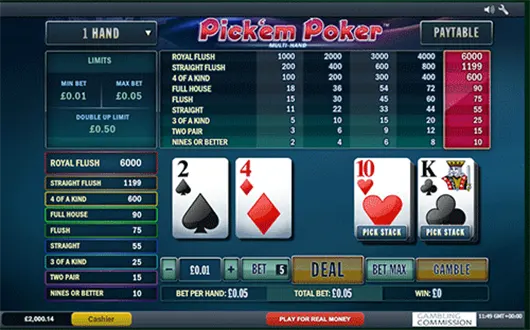
The game begins with two cards already displayed on the screen. For each of the remaining positions, the player is shown two face-up card options and must select one of them. After making three selections, a complete five-card poker hand is formed. The final hand is then evaluated according to the paytable used by the specific version of Pick’em Poker.
Unlike traditional video poker, where players receive five cards and decide which cards to hold, Pick’em Poker removes the draw phase entirely. Every decision revolves around choosing the stronger card from a pair of visible options. This creates a more transparent playing experience because players know exactly which alternatives are available before making a choice.
Most Pick’em Poker games use a paytable that rewards common poker combinations such as pairs, two pairs, three of a kind, straights, flushes, full houses, four of a kind, straight flushes and royal flushes. However, payout percentages may differ between software providers, making it important to review the paytable before playing.
How Hand Formation Differs from Standard Video Poker
In classic video poker, players must decide which cards to keep and which cards to discard. The replacement cards are drawn randomly from the remaining deck. As a result, outcomes depend heavily on probability calculations involving unseen cards.
Pick’em Poker changes this concept by presenting visible alternatives. Since the possible outcomes are known before a selection is made, players can make more informed choices. This feature reduces some uncertainty while introducing a different type of strategic thinking.
The visible card pairs often create situations where players must choose between building a made hand immediately or pursuing a stronger combination with a potentially higher payout. These decisions form the core of Pick’em Poker strategy and distinguish it from traditional video poker variants.
Basic Strategy for Pick’em Poker
The first principle of successful Pick’em Poker play is understanding hand rankings and payout values. When two card options are available, the choice should not be based solely on the current strength of the hand. Players should also consider the potential value of future combinations that can be completed with subsequent selections.
High pairs generally deserve priority because they frequently lead to guaranteed payouts. However, there are situations where selecting a suited card or a card that extends a straight draw may provide a better expected return than securing a low-value hand immediately.
Bankroll management remains important despite the strategic nature of the game. Because outcomes are still influenced by chance, players should use betting limits appropriate for their budget and avoid increasing stakes after short-term losses.
Common Decision-Making Mistakes
One of the most frequent mistakes is focusing only on the current hand rather than considering future possibilities. Choosing a card that creates a small pair may seem attractive, but it can eliminate opportunities for flushes, straights or higher-paying combinations.
Another error involves ignoring the paytable. Different Pick’em Poker versions may reward certain hands more generously than others. Strategic decisions should always reflect the actual payout structure rather than assumptions based on other video poker games.
Many players also underestimate the value of drawing toward premium hands. Although smaller wins occur more frequently, larger combinations often contribute significantly to the overall return percentage when optimal decisions are made consistently.
Key Differences Between Pick’em Poker and Classic Video Poker
The most obvious difference is the card-selection system. Traditional video poker revolves around holding and discarding cards, whereas Pick’em Poker requires choosing between visible alternatives. This fundamentally changes the way probability and strategy are applied during gameplay.
Another distinction is the level of information available to the player. In standard video poker, replacement cards remain unknown until they are dealt. In Pick’em Poker, players can see the available options before making a decision, creating a more analytical experience.
The pace of the game is also different. Since there is no draw phase, rounds are often completed more quickly. At the same time, strategic choices remain important because every card selection directly affects the final outcome.
Who May Enjoy Pick’em Poker the Most
Players who appreciate strategic decision-making often find Pick’em Poker appealing because every choice is based on visible information rather than hidden draws. The format rewards careful analysis and attention to hand potential.
Fans of traditional video poker may also enjoy the game as an alternative that preserves familiar poker rankings while introducing a different approach to constructing winning hands. The learning curve is relatively gentle for anyone already familiar with poker combinations.
For newcomers, Pick’em Poker can serve as an accessible introduction to video poker concepts. Since players select from visible options instead of managing holds and discards, the mechanics are straightforward while still providing meaningful strategic depth.